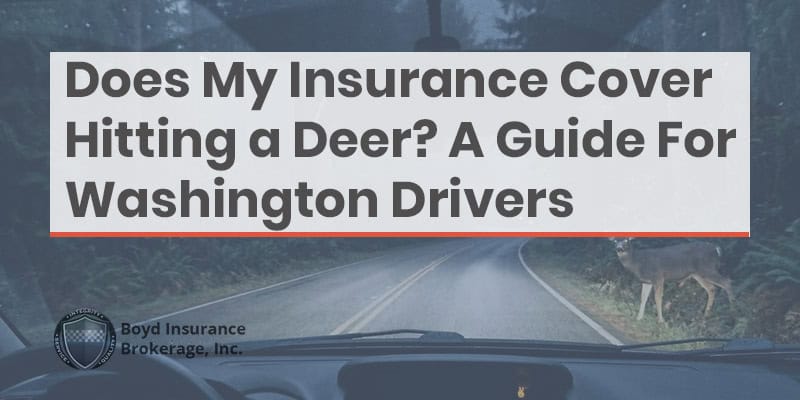
If you hit a deer in Washington, your insurance covers the damage only if you carry comprehensive coverage — not liability-only. Comprehensive pays for animal collisions minus your deductible and is usually treated as a not-at-fault claim, so it has little effect on your rates.
Living in Washington gives us access to some of the most beautiful drives in the country. But whether you are commuting on I-90 or taking the back roads through the Palouse, sharing the road with wildlife is a daily reality. According to State Farm, Washington drivers have a 1 in 118 chance of hitting a deer or large animal this year. When that thud happens, your first worry is safety. Your second is almost always: “Is this going to be covered?”
The short answer is: It depends on your specific policy coverage. Here is a breakdown of how auto insurance handles deer collisions in Washington state.
The Magic Word: “Comprehensive”
Many drivers assume that having “full coverage” covers everything. However, in the insurance world, “full coverage” is just a slang term. To be covered for hitting a deer, you specifically need comprehensive coverage on your policy.
- Comprehensive coverage: This pays for damage to your vehicle caused by events that are “other than collision.” This includes fire, theft, vandalism, falling trees, and—you guessed it—hitting an animal.
- Liability only: If you have a basic liability policy (which only covers damage you cause to others), you will have to pay for your own car repairs out of pocket.
The deductible applies:
If you have comprehensive coverage, the insurance company will pay for the repairs minus your deductible. For example, if the repair costs $4,500 and your comprehensive deductible is $500, the insurance company pays $4,000.
The “Swerve” Trap: A Critical Warning
This is the most important advice we give our clients, and it is the hardest to follow in the heat of the moment: If you cannot safely stop, do not swerve.
Insurance companies distinguish between hitting the deer and avoiding the deer:
- You hit the deer: This is a comprehensive claim. It is generally considered a “not-at-fault” accident because deer are unpredictable. Your rates generally will not go up as much (or at all) compared to an at-fault accident.
- You swerve to miss the deer and hit a tree/guardrail: This is now classified as a collision claim. Because you hit a stationary object, you are considered “at fault.” You will have to pay your (usually higher) collision deductible, and your insurance rates will likely increase significantly.
As difficult as it is, braking in a straight line is often the safest financial and physical choice.
Does a Deer Accident Affect My Rates?
In Washington, comprehensive claims (like hitting a deer) generally have a much smaller impact on your insurance premiums than collision claims. Many carriers view wildlife accidents as bad luck rather than bad driving.
However, if you have a history of multiple claims in a short period, it could still affect your renewal eligibility.
What should you do if you hit a deer in Washington?
If you are unfortunate enough to have a run-in with a deer, elk, or moose, follow these steps to ensure your claim goes smoothly:
- Safety first: Move your car off the road and turn on your hazards. Do not approach the injured animal; they can be dangerous.
- Call the police: In Washington, if damages appear to be over $1,000 (which is almost any bodywork these days), you should file a report. This police report serves as official proof that an animal was involved, which helps your adjuster process the claim as “comprehensive” rather than “collision.”
- Take photos: Take pictures of the damage to your vehicle and the scene. If there is fur or evidence of the animal on the car, photograph that too.
- Call Boyd Insurance: Contact us before you call the 1-800 number. We can help you estimate if the damage exceeds your deductible and advise you on whether filing a claim makes financial sense.
Review Your Comprehensive Deductible Today
Deer season doesn’t wait for your bank account to be ready. If your comprehensive deductible is set to $1,000 or more to save a few dollars on premiums, you might be facing a hefty bill if a deer jumps out tonight.
Let us review your policy to ensure you have the right protection for Washington roads. Call Boyd Insurance Brokerage Inc. today at (509) 340-2693.
Frequently Asked Questions
Does insurance cover hitting a deer in Washington?
Yes, if you have comprehensive coverage, which pays for animal collisions minus your deductible. Liability-only policies won’t cover your own vehicle’s damage. Comprehensive also covers other non-collision events like a cracked windshield.
Will hitting a deer raise my insurance rates?
Usually not much. Animal collisions are filed as comprehensive, not-at-fault claims, which have a smaller impact on premiums than at-fault collision claims.
Should I swerve to avoid hitting a deer?
No, if you can’t stop safely. Swerving into a tree or guardrail becomes an at-fault collision claim with a higher deductible and likely rate increase — braking in a straight line is often the safer financial and physical choice.
Do I need a police report after hitting a deer?
In Washington, if the damage appears to exceed $1,000 you should file a police report. It serves as proof an animal was involved, helping your claim be processed as comprehensive rather than collision.