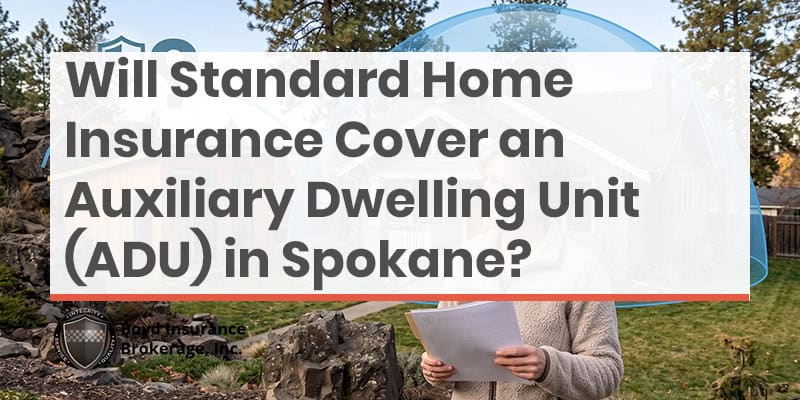
With the passage of Washington state laws like HB 1337, which allows up to two ADUs per lot in urban areas like Spokane, and the new 2026 rural ADU law (HB 1345), accessory dwelling units are booming across the Inland Northwest. Whether building a backyard cottage, finishing a basement suite, or converting a garage, an ADU adds immense value to a property.
But does a standard homeowners policy cover this new structure?
The short answer is: it depends heavily on how the ADU is built and who is living in it. Standard home insurance might offer some protection, but it usually falls short of what is actually needed. Here is a technical breakdown of how insurance coverage works for ADUs in Washington.
How the Structure is Covered: Attached vs. Detached
Insurance carriers categorize an ADU based on its physical connection to the main house.
Attached ADUs
If an ADU is an interior conversion, like a basement apartment or an attached garage suite that shares a roof and walls with the primary home, it is generally covered under Coverage A (Dwelling Coverage) of a standard homeowners policy. The homeowner will need to increase the Coverage A limit to account for the added square footage and finishes, but the structure itself is usually covered without a separate policy.
Detached ADUs
If a homeowner builds a freestanding backyard cottage, insurance considers this an “other structure,” which falls under Coverage B.
The Coverage B Limitation Trap
This is the most common insurance mistake Spokane homeowners make with ADUs. A standard homeowners policy automatically limits Coverage B (Other Structures) to 10% of the primary dwelling coverage.
For example, if the main home is insured for $400,000, the detached ADU is only covered up to $40,000. Because a new, fully permitted detached ADU in Spokane can easily cost between $150,000 and $250,000 to construct, standard Coverage B will leave the property massively underinsured if a fire or severe windstorm destroys the unit. The homeowner must specifically endorse the policy to increase the “Other Structures” limit to match the ADU’s actual replacement cost.
How Usage Impacts Coverage
The physical structure is only half the equation. Insurance companies also base coverage on who occupies the space.
Family Use
If aging parents, an adult child, or an extended family member lives in the ADU, most standard homeowners policies will extend liability and structural coverage to the unit, provided the Coverage B limits are updated. The family member will simply need their own renters’ policy to cover personal belongings.
Long-Term Renters
If the ADU is leased to a non-family tenant under a standard 12-month lease, homeowners’ insurance will treat it as a commercial exposure. Standard personal liability will not cover the homeowner if a tenant is injured on the property, and property damage caused by the tenant may be excluded. In this scenario, a separate landlord policy (often called a Dwelling Fire policy) is required specifically for the ADU, or a rental property endorsement must be added to the main policy.
Short-Term Rentals
If the ADU will be used as an Airbnb or VRBO, standard homeowners’ insurance will absolutely not cover the business risks associated with transient lodging. A commercial short-term rental policy is required to cover property damage, loss of business income, and commercial liability.
Update the Policy Before Construction
Never assume an ADU is automatically covered. Building an auxiliary dwelling unit without notifying the insurance carrier can void aspects of the coverage. Before pulling permits with the City of Spokane or breaking ground, call Boyd Insurance Brokerage Inc at (509) 340-2693. We will review current limits, assess how the space will be used, and structure the exact home coverage needed to protect the investment.